Privacy Policy – Kochek Company, LLC
Effective Date: 9/6/2023
Kochek Company, LLC (“us”, “we”, or “our”) operates the www.kochek.com website as well as the www.kochekportal.com website, and all other internet websites owned by us.
This page informs you of our policies regarding the collection, use and disclosure of personal data when you use our Service and the choices you have associated with that data.
We use your data to provide and improve the Service. By using the Service, you agree to the collection and use of information in accordance with this policy. Unless otherwise defined in this Privacy Policy, the terms used in this Privacy Policy have the same meanings as in our Terms and Conditions. There are times when we will request information from you. Our goal in collecting this personal information is to offer you the most relevant information about our products and services based on your interests.
If you want your personal information dropped from our database, you can send an email to [email protected] that says ‘remove my user name’ or similar language at any time.
Definitions
“Service” – Service means the www.kochek.com and the www.kochekportal.com websites, and all other internet websites operated by Kochek Company, LLC.
“Personal Data” – Personal Data means data about a living individual who can be identified from those data (or from those and other information either in our possession or likely to come into our possession).
“Usage Data” – Usage Data is data collected automatically either generated by the use of the Service or from the Service infrastructure itself (for example, the duration of a page visit).
“Cookies” – Cookies are small files stored on your device (computer or mobile device).
“Information Collection and Use” – We collect several different types of information for various purposes to provide and improve our Service to you.
Types of Data Collected
Personal Data
While using our Service, we may ask you to provide us with certain personally identifiable information that can be used to contact or identify you (“Personal Data”). Personally identifiable information may include, but is not limited to: Email address; First name, Middle name and Last name; Phone number; Street Address, City, County, State, Country, ZIP/Postal code. We may use your Personal Data to contact you with newsletters, marketing or promotional materials and other information that may be of interest to you.
Usage Data
We may also collect information that your browser sends whenever you visit our Service or when you access the Service by or through a mobile device (“Usage Data”). This Usage Data may include information such as your computer’s Internet Protocol address (e.g. IP address), browser type, browser version, the pages of our Service that you visit, the time and date of your visit, the time spent on those pages, unique device identifiers and other diagnostic data.
When you access the Service with a mobile device, this Usage Data may include information such as the type of mobile device you use, your mobile device unique ID, the IP address of your mobile device, your mobile operating system, the type of mobile Internet browser you use, unique device identifiers and other diagnostic data.
Location Data
We may use and store information about your location. We use this data to provide features of our Service, to improve and customize our Service. You can enable or disable location services when you use our Service at any time by way of your device settings.
Tracking & Cookies Data
We use cookies and similar tracking technologies to track the activity on our Service and we hold certain information. Cookies are files with a small amount of data which may include an anonymous unique identifier. Cookies are sent to your browser from a website and stored on your device. Other tracking technologies are also used such as beacons, tags and scripts to collect and track information and to improve and analyze our Service. You can instruct your browser to refuse all cookies or to indicate when a cookie is being sent. However, if you do not accept cookies, you may not be able to use some portions of our Service.
Use of Data
Kochek Company, LLC uses the collected data for various purposes:
To provide and maintain our Service
To notify you about changes to our Service
To allow you to participate in interactive features of our Service when you choose to do so
To provide customer support
To gather analysis or valuable information so that we can improve our Service
To monitor the usage of our Service
To detect, prevent and address technical issues
To provide you with news, special offers and general information about other goods, services and events which we offer that are similar to those that you have already purchased or enquired about unless you have opted not to receive such information.
Transfer of Data
Your information, including Personal Data, may be transferred to – and maintained on – computers located outside of your state, province, country or other governmental jurisdiction where the data protection laws may differ from those of your jurisdiction.
If you are located outside United States and choose to provide information to us, please note that we transfer the data, including Personal Data, to the United States and process it there.
Your consent to this Privacy Policy followed by your submission of such information represents your agreement to that transfer.
Kochek Company, LLC will take all the commercially reasonably steps necessary to ensure that your data is treated securely and in accordance with this Privacy Policy and no transfer of your Personal Data will take place to an organization or a country unless there are adequate controls in place including the security of your data and other personal information.
Disclosure of Data
Disclosure for Law Enforcement
Under certain circumstances, Kochek Company, LLC may be required to disclose your Personal Data if required to do so by law or in response to valid requests by public authorities (e.g. a court or a government agency).
Legal Requirements
Kochek Company, LLC may disclose your Personal Data in the good faith belief that such action is necessary to:
To comply with a legal obligation
To protect and defend the rights or property of Kochek Company, LLC
To prevent or investigate possible wrongdoing in connection with the Service
To protect the personal safety of users of the Service or the public
To protect against legal liability
Security of Data
The security of your data is important to us but remember that no method of transmission over the Internet or method of electronic storage is 100% secure. While we strive to use commercially acceptable means to protect your Personal Data, we cannot guarantee its absolute security.
Our Policy on “Do Not Track” Signals under the California Online Protection Act (CalOPPA)
We do not support Do Not Track (“DNT”). Do Not Track is a preference you can set in your web browser to inform websites that you do not want to be tracked.
You can enable or disable Do Not Track by visiting the Preferences or Settings page of your web browser.
Service Providers
We may employ third party companies and individuals to facilitate our Service (“Service Providers”), provide the Service on our behalf, perform Service-related services or assist us in analyzing how our Service is used.
These third parties have access to your Personal Data only to perform these tasks on our behalf and are obligated not to disclose or use it for any other purpose.
Analytics
We may use third-party Service Providers to collect data and website traffic, to track, monitor, analyze, and report on the use of our Service. These Service Providers may use the collected data to contextualize and personalize the ads of their own advertising networks.
Payments
We may provide paid products and/or services within the Service. In that case, we will use third-party services for payment processing (e.g. payment processors). We will not store or collect your payment card details on the Service. That information is provided directly to our third-party payment processors whose use of your personal information is governed by their Privacy Policy.
Links to Other Sites
Our Service may contain links to other sites that are not operated by us. If you click a third-party link, you will be directed to that third party’s site. We strongly advise you to review the Privacy Policy of every site you visit.
We have no control over and assume no responsibility for the content, copyrights, privacy policies or practices of any third-party sites or services.
We may make available forums, message boards and news groups for our customer communities from time to time. Please remember that any information that is disclosed in these areas becomes public information and you should exercise caution when deciding to disclose personal information.
Children’s Privacy
Our Service does not address anyone under the age of 18 (“Children”).
We do not knowingly collect personally identifiable information from anyone under the age of 18. If you are a parent or guardian and you are aware that your Child has provided us with Personal Data, please contact us. If we become aware that we have collected Personal Data from children without verification of parental consent, we take steps to remove that information from our servers.
Changes to This Privacy Policy
Kochek Company, LLC reviews its privacy practices from time-to-time (i.e. to track technology and/or legal changes), and these practices are subject to change. We reserve the right, at any time, to modify, alter, or update this policy, and any such modifications, alterations, or updates will be effective upon posting. To ensure continuing familiarity with the most current version of our privacy policy, please bookmark and periodically review this page.
Contact Us
If you have any questions about this Privacy Policy, please contact us:
By email: [email protected]
By visiting this page on our website: https://kochek.com/contact/
By phone number: +1-860-963-3377


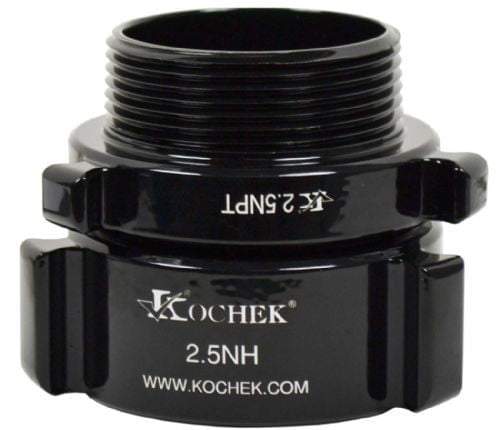

 When figuring out what your part number should be for a Kochek fitting with pipe or any threads not NH, remember sizes are stated in this order: first- Storz size, next- Female thread size, and lastly- Male thread size. You can also use this legend to help: